
The Social Media Manager’s Therapy Kit: Tools For Surviving Burnout


Do you feel overworked in your position as a social media manager? Are you experiencing burnout but aren’t quite sure if you can overcome it?
Burnout in creative fields is quite common, so common that it almost feels inevitable.
In this post, we examine what burnout is and what causes it among social media managers before discussing tools and systems you can use to survive it.
What is social media manager burnout?
Burnout is a mental state in which prolonged and unmanaged stress and anxiety lead to fatigue, feelings of being overwhelmed, depression and eventually hopelessness.
It can also lead to productivity issues, particularly issues with starting and completing tasks or completing them in a timely manner. You may also avoid tasks altogether.
Burnout can occur in every aspect of life, but it’s most often associated with work.
Social media manager burnout is part of a subcategory of burnout known as “occupational burnout.” It occurs among marketing professionals who specialize in social media.
You might be experiencing burnout as a social media manager if you’re feeling overwhelmed by the number of tasks you’re required to handle at a time, stressed about your work even when it you feel it should be manageable, depressed and unable to enjoy activities outside of work, and other feelings that affect your mental health.
It’s important to know that these feelings are perfectly normal and almost expected from a job that’s as busy as social media itself.
Oftentimes, you’re required to work on a lot of different tasks, some of which might not even be 100% related to social media. You might even find yourself working long hours in order to get everything done.
It’s only natural to feel emotionally (and sometimes physically) drained from a job that expects so much from you, especially if you feel as though your salary doesn’t match the amount of skill and value you bring to your company.
What causes burnout among social media managers?
Hootsuite surveyed over 3,000 social media marketers in 2023. This revealed quite a few things about the workload members of this field are required to manage as well as other things that demonstrate why burnout is so prevalent in this industry.
Let’s start with hardships.
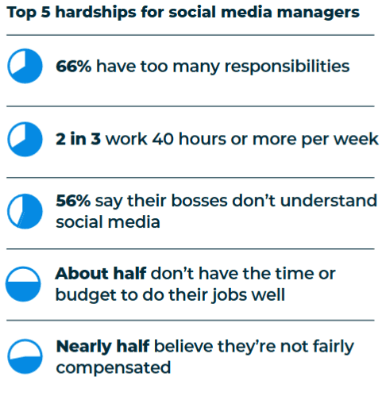
According to social media managers, these are the top five hardships they experience in their careers:
- Too many responsibilities – 66% say they have too many
- Long hours – 2 in 3 say they work 40 hours or more per week
- Disconnection with bosses – 56% say their bosses don’t understand social media
- Work constraints – Around half say budget and time constraints prevent them from doing their jobs well
- Compensation – Almost half say they’re not being fairly compensated
According to Hootsuite’s report, social media managers juggle nine tasks at one time, which are writing copy, shooting content, editing content, scheduling posts, creating ads, building strategies, tracking analytics, monitoring comments and mentions, and managing influencer marketing campaigns.
Social media teams are also pretty small. 38% of social media managers work alone while 29% work with a team of two to three people.
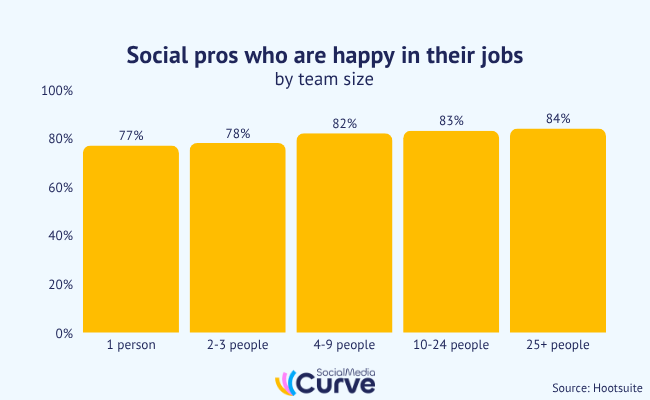
Even more interesting, Hootsuite’s report shows how team size has an impact on the happiness levels of social media marketers.
77% of social media marketers who work alone are happy with their jobs compared to 84% of social media marketers who are part of a team of more than 25 people.
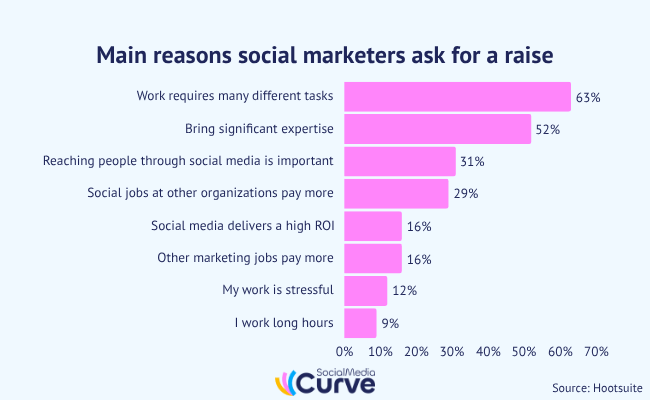
The majority of social media marketers say their workload is the number one reason why they’d ask for a pay raise.
To be specific, 63% say this is the reason why they’d ask for a pay raise. 52% say they’d ask for one because they bring a lot of skill and expertise to their jobs, 12% say it’s because their work is stressful, and 9% say it’s because they work long hours.
48% of social media managers who often work overtime also say their jobs have a negative impact on their mental health.
This is most prevalent among social media managers who are required to handle a lot of non-social media tasks, such as managers who also work as head of marketing or are part of the company’s PR team.
In fact, 75% of social media marketers who spend less than 10% of their time handling social media tasks often feel overwhelmed and overburdened by their workloads.
This is in comparison to 55% of social media marketers who spend more than 90% of their time handling social media tasks.
These might just be statistics or numbers on a screen, but they represent data collected from over 3,000 real social media marketers. They prove that many companies expect a lot from social media managers, and it’s affecting their mental health and overall satisfaction with their jobs.
Tools and systems for surviving social media burnout
We’ve curated a list of tools and systems you can use to mitigate the stress and anxiety that has you feeling overwhelmed with your work.
We’ve divided them into different categories:
- Management – Tools to help you organize your tasks and posting schedule.
- Boundaries – Tools and systems to help you create boundaries between your work life and your personal life.
- Fulfillment – Systems to help you feel more fulfilled with your life in general.
- Wellness – Tools and systems to help you manage your mental health.
- Community – A list of online communities you can join to help you feel less alone in your career.
Management
Quitting jobs on a whim is not realistic in jobs that require expertise. There’s no guarantee that you’ll be hired in the same position by another company, and it doesn’t look good in your work history.
So, if you’re feeling overwhelmed by your workload, your best bet is to manage it more efficiently.
You can do this with project management tools and social media management tools.
You might think these are one and the same, but they each have a place in your workday.
Use project management tools to manage individual ideas and campaigns, and use social media management tools to manage your schedule, create posts, monitor comments and mentions, and track engagements.
Project management tools like Trello, Monday, Asana and ClickUp are great for helping you manage tasks on a digital board and arrange them by priority and where they are in terms of completion.
You can add checklists to individual tasks, attach files, give due dates and assign team members.
Project management apps even let you create different boards, such as one for influencer marketing campaigns, one for an individual campaign and one for different strategies.
A social media management tool helps you with the following tasks:
- Social media calendar – Managing your entire social media posting schedule across every platform you publish to.
- Social media scheduling – Scheduling posts for multiple platforms from a single draft. This means you no longer need to log into each individual platform to publish a post to it. You just schedule one post from a single dashboard, optimize it for each platform you want to publish it to, schedule it, and wait for the tool to post it automatically.
- Social media inbox – Responding to comments and direct messages from multiple platforms in one location.
- Social listening – Monitoring brand mentions from multiple platforms.
- Analytics – Tracking your performance using different metrics.
We mostly recommend Sendible for social media management. It offers all of these features plus additional features for teams, reports, content libraries, UTM tracking and more.
Check out our review of Sendible if you want to learn more.
We recommend Pallyy for social media managers on strict budgets.
Boundaries
Setting up boundaries that separate your work life from your personal life is essential for surviving burnout as a social media manager.
You might be tempted to use a single device and log into your work’s social media accounts and your personal accounts simultaneously and just switch between them, but this is ill advised.
You’ll still receive notifications for your work’s accounts, so the temptation to work will always be there. You’ll say to yourself, “it’s just one reply” or “one direct message,” then the next thing you know, two hours have gone by, and you’ve replied to every comment and direct message you’ve received from the past week.
It’s best to choose a time to clock out at everyday, and stick to it. Don’t log into your work accounts after that time, and do not work at all until you clock in the next day.
The easiest way to make sure you do this is to have at least two devices: one for work and one for your personal life.
Ask your work to provide this if you can’t afford one yourself. Explain the importance of having a dedicated work phone for security purposes.
Choosing a definitive clock-out time also applies to work-related messages and other inquiries from your boss, co-workers and team members.
Do not respond to messages when you’re off the clock. If you communicate through Slack, use Slackbot to set up auto messages that send messages automatically based on keywords, such as your @.
If your username is “spunkytaco,” set up an auto message that triggers when someone uses “@spunkytaco” in their message. It could say something as simple as “Jasmine is off the clock right now, but she’ll get back to you as soon as she clocks back in!”
You can also edit your status in Slack to let your co-workers know you’re off the clock.
You might also want to consider not using social media at all in your personal life while you’re experiencing burnout from work. Combining this tactic with the clock-out method is a great way to detox from social media on a daily basis.
Fulfillment
Along with creating boundaries between your work life and personal life, you should also put more of an effort into making your personal life more fulfilling.
This ensures that no matter how stressful your work life becomes, you always have ways to decompress when you’re off the clock.
Try to socialize more outside of work. Surround yourself with supportive personalities who fill your life with joy.
Take part in hobbies you’ve been neglecting, and do things that are fulfilling to you personally.
You can also volunteer more often if working too many hours on building up a company’s image has you feeling as though your life has no meaning or a true purpose.
Wellness
Wellness can be difficult to incorporate into your life, especially if burnout is impacting your mental health and making it difficult for you to maintain a healthy lifestyle, but it’s vital for your survival.
Start with the basics, things we all should do to improve our mental health:
- Exercise several times throughout the week
- Eat a healthy, well-balanced diet
- Develop routines for your work life and personal life
- Develop schedules that help you separate your work life from your personal life
- Keep a journal to help you track your schedule, moods and habits
These are lifestyle changes that can have a profound effect on your mental health. They might eventually help you manage stress, anxiety and other symptoms of burnout more effectively.
Other wellness techniques are things you can try when burnout is having a profound impact on your mental health to the point where you can no longer focus on work or are having panic attacks and emotional breakdowns in the middle of the workday.
There’s a technique called “dopamine detox” in which you unplug from screens and spend more of your time offline in an attempt to reset your brain and not let it feed off of the dopamine you receive from scrolling social media.
Because your job requires you to use social media quite a bit, you’re at a higher risk of experiencing “digital addiction.”
Many social media managers who experience burnout try to use social media less or not at all in their personal lives.
If you experience panic attacks and emotional distress, try to find a coping technique that works for you, such as stimulating your vagus nerve by inhaling through your nose, holding your breath for four seconds, then slowly exhaling through your lips. This breathing exercise is meant to trigger a calming effect.
You can also try going for a quick walk if your work environment allows you to leave the office whenever you need to.
If things get really bad, you might need professional help. Therapists can help you talk through the emotions you’re experiencing, and they may even give you coping techniques for cognitive behavior therapy (CBT).
Finally, it might be a shot in the dark, but there might also be the possibility that you have a mental disorder or illness that affects your mental health that didn’t become more prevalent until your work life caused you to experience more stress than normal.
Mental disorders like ADHD, mood disorders, conditions like PMDD that affect hormones, and thyroid disorders that cause depression and impede your ability to focus can make symptoms of burnout more severe.
Certain individuals may even be more susceptible to burnout, such as individuals with bipolar disorder who overwork themselves during periods of mania.
Getting these disorders and illnesses diagnosed and treated might make it easier for you to manage symptoms of burnout.
Community
If you’re having trouble managing burnout, discuss your feelings with fellow social media managers, some of whom are likely experiencing the same symptoms.
Reddit has the following subreddits:
- r/socialmediamanagers
- r/findapath (this one’s for folks questioning their careers)
- r/socialmediamarketing
Facebook has a private group called Social Media Managers, and Glassdoor has a community called Marketing.
You can find posts about burnout in these communities already, but you can also make your own.
It might also be nice to communicate with fellow social media marketers on a regular basis.
How to prevent burnout as a social media manager
The leading causes of burnout among social media managers seem to be having to perform too many tasks at one time, having to perform tasks that don’t relate to social media and having to work long hours.
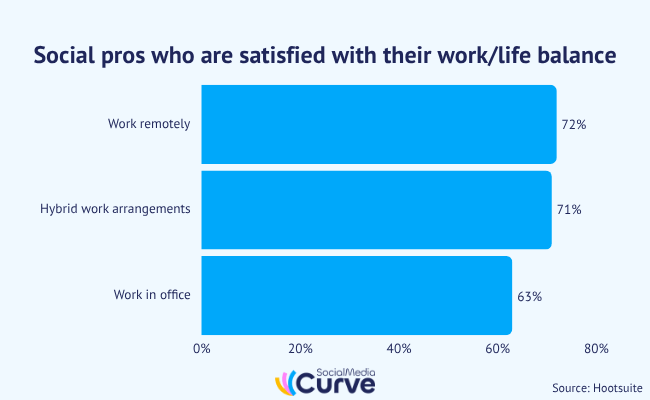
In Hootsuite’s report, they also discovered that 72% of social media marketers who work remotely are satisfied with their work/life balance compared to 63% of marketers who work in the office.
They also discovered that although 77% of social media marketers say their companies offer healthcare coverage, only 33% say their companies offer mental health coverage.
With all that in mind, here are some tips for preventing burnout:
- Work for a company you believe in. You’re going to spend a lot of time creating content for this company and building up their image. Make sure you feel good about doing so.
- Find a salaried position if you’re a freelancer so you can focus on creating content for one brand instead of several.
- Create and schedule content in advance, up to a month if you can. This way, you have time to take it easy if you need to.
- Switch to remote work if your company allows it.
- Work for a company that offers mental health coverage.
- Convince your boss to hire more employees. Pitch this idea from the company’s point of view and how it will grow their following.
- Consider leaving management. Job satisfaction seems to be lower among individuals who are in charge of a lot of different tasks rather than tasks that relate specifically to social media.
